Autonomous Greenhouse Inspection Robot
A mobile manipulator that maps a greenhouse, drives between flower beds and scans each bed with an arm-mounted camera, reporting where every flower and pest is.
Problem and motivation
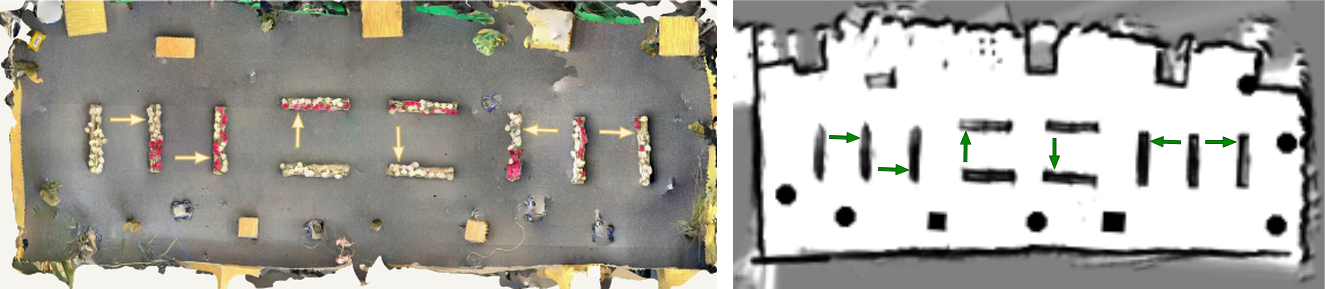
Monitoring crops by hand is slow. The goal was a low-cost robot that builds a map of the greenhouse, drives to each flower bed on its own, and reports which flowers are where and whether pests are present, on the open-source MIRTE Master mobile manipulator.
System
The robot runs a ROS 2 stack in three stages:
- Mapping. The greenhouse is mapped once by teleoperation with
slam_toolbox, and a waypoint is saved in front of each flower bed. - Navigation. The robot localises on that map with AMCL and drives between the waypoints with Nav2, updating its local costmap to avoid obstacles that are not on the map.
- Bed scanning. At each waypoint, a state-machine node runs the multi-step scan through ROS 2 actions and services: it positions the arm, captures images with the close-range camera on the gripper, and hands them to the detector. Keeping this in one node keeps the detector and the GUI decoupled.
Perception
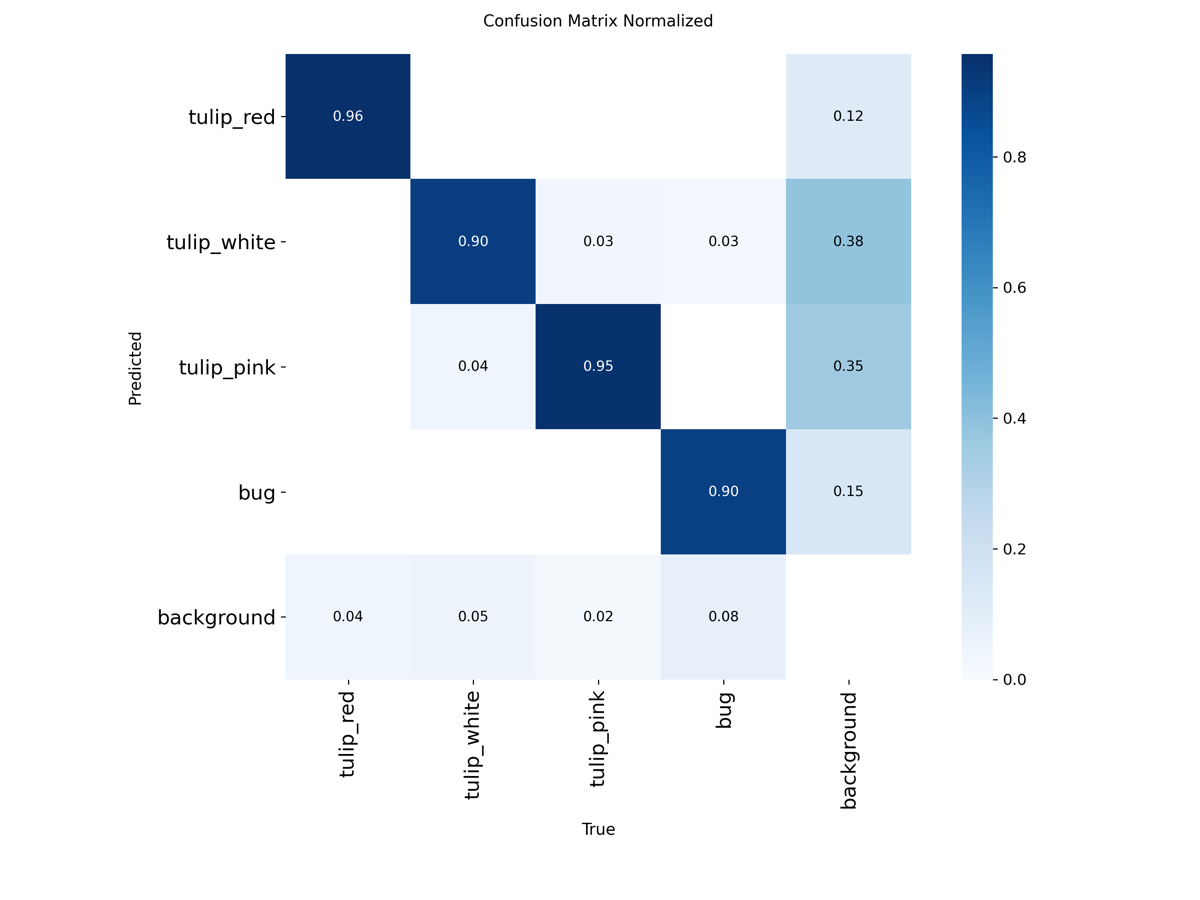
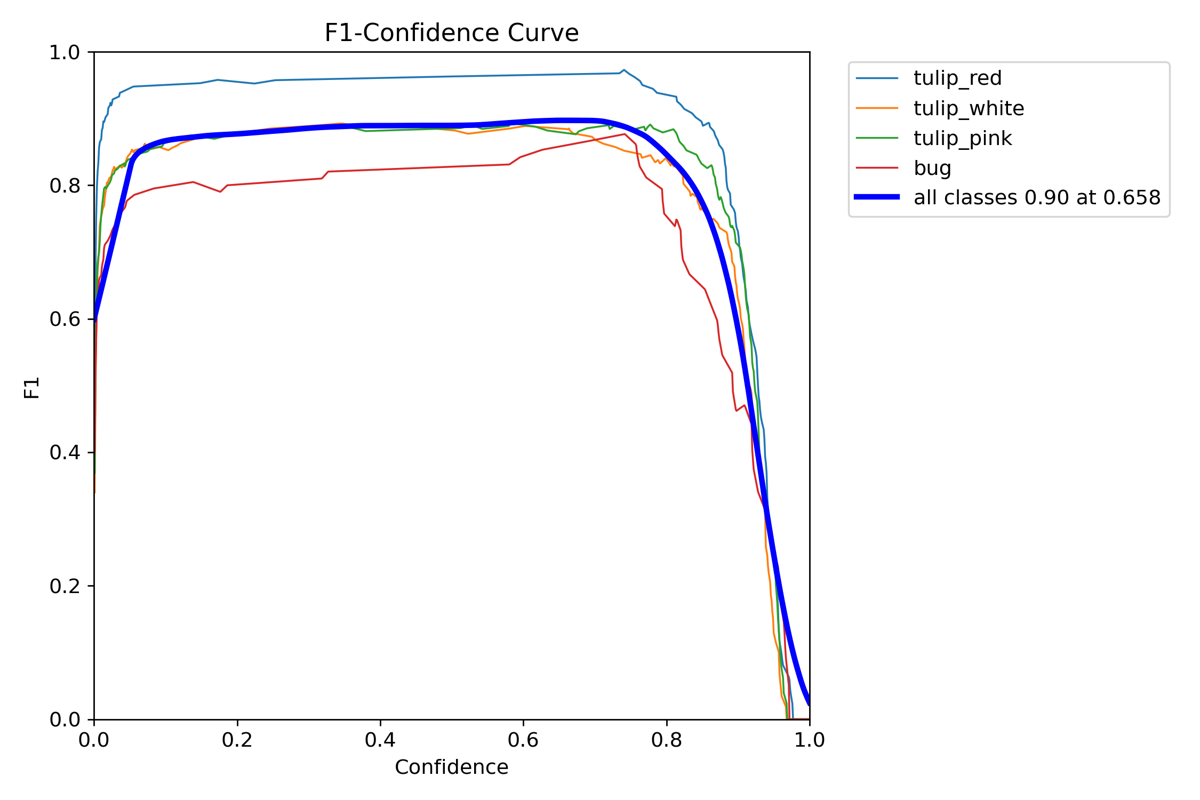
- Detector. I fine-tuned a YOLOv8n model for four classes (red, white and pink tulips, and bugs). On the held-out test split (86 images) it reaches mAP@50 0.92 (mAP@50-95 0.69), with precision 0.91 and recall 0.88, and the F1 score stays above 0.85 over a wide range of confidence thresholds. It runs live on the robot’s camera.
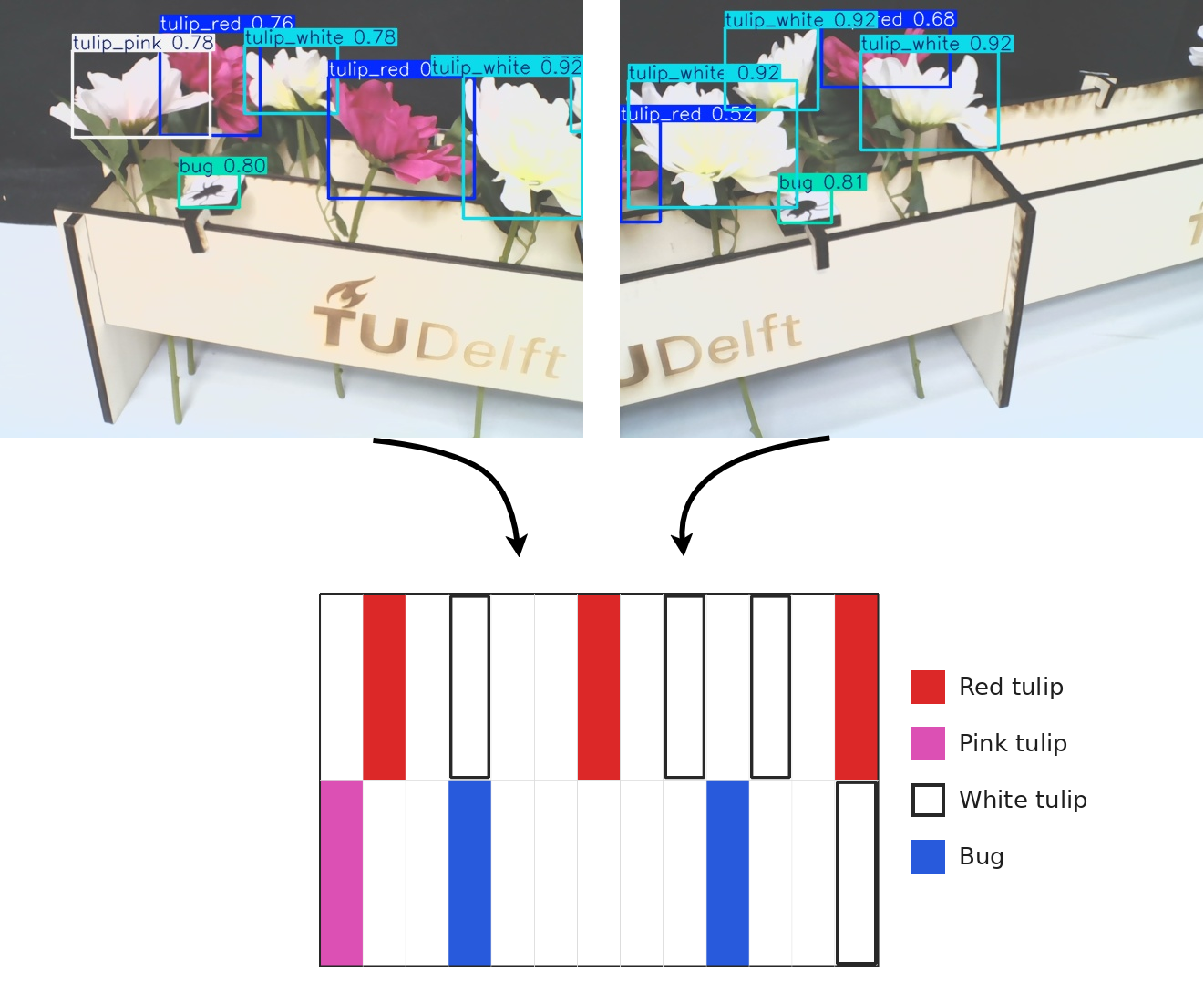
- From detections to a bed map. A homography projects detections from the left and right views of a bed onto its grid (two rows, thirteen columns), and an outlier filter merges duplicate sightings so a flower seen twice is counted once.
Results
On eight hand-annotated captures (54 objects), 89% of detections land in the correct cell or a neighbouring one; exact-cell accuracy is 44%. The errors were traced to the robot’s base position relative to the bed rather than to the detector, so for the final demonstration I recalibrated the homography by averaging over a sequence of captures instead of a single image.
What I learned
Perception is only useful once its output is in a form the rest of the system can act on. Most of the work was not the detector but getting reliable bed positions out of it, and the main error source turned out to be where the robot stood, not what the network saw.