Real-Time Control Testbed for 6G Networks
A hand-teleoperated ball-balancing table for the 6G-SANDBOX, used to show how network latency and where the computation runs affect a control task that needs fine precision.
Problem and motivation
When sensing, computation and actuation are spread over a network, every link adds delay, and delay degrades closed-loop control. The testbed makes that effect visible with a task that needs fine control: guiding a ball through a maze on a tilting table, teleoperated by hand.
System
- Teleoperation. The operator steers with their hands: gloves track the hand skeleton, and hand poses become commands for the ball. I implemented the ML-based skeletal hand tracking and the C++ interfaces that turn the raw hardware signals into real-time skeletal data.
- Control. The ball-balancing table closes the loop on the ball’s position and tracks the operator’s commands; the data moves between machines over UDP, and I optimised that pipeline for low latency.
- Network and compute scenarios. The same task runs over different links (Ethernet, Wi-Fi and 5G) and with the computation placed in different spots, from local to edge, so its control performance can be compared across network and compute set-ups.
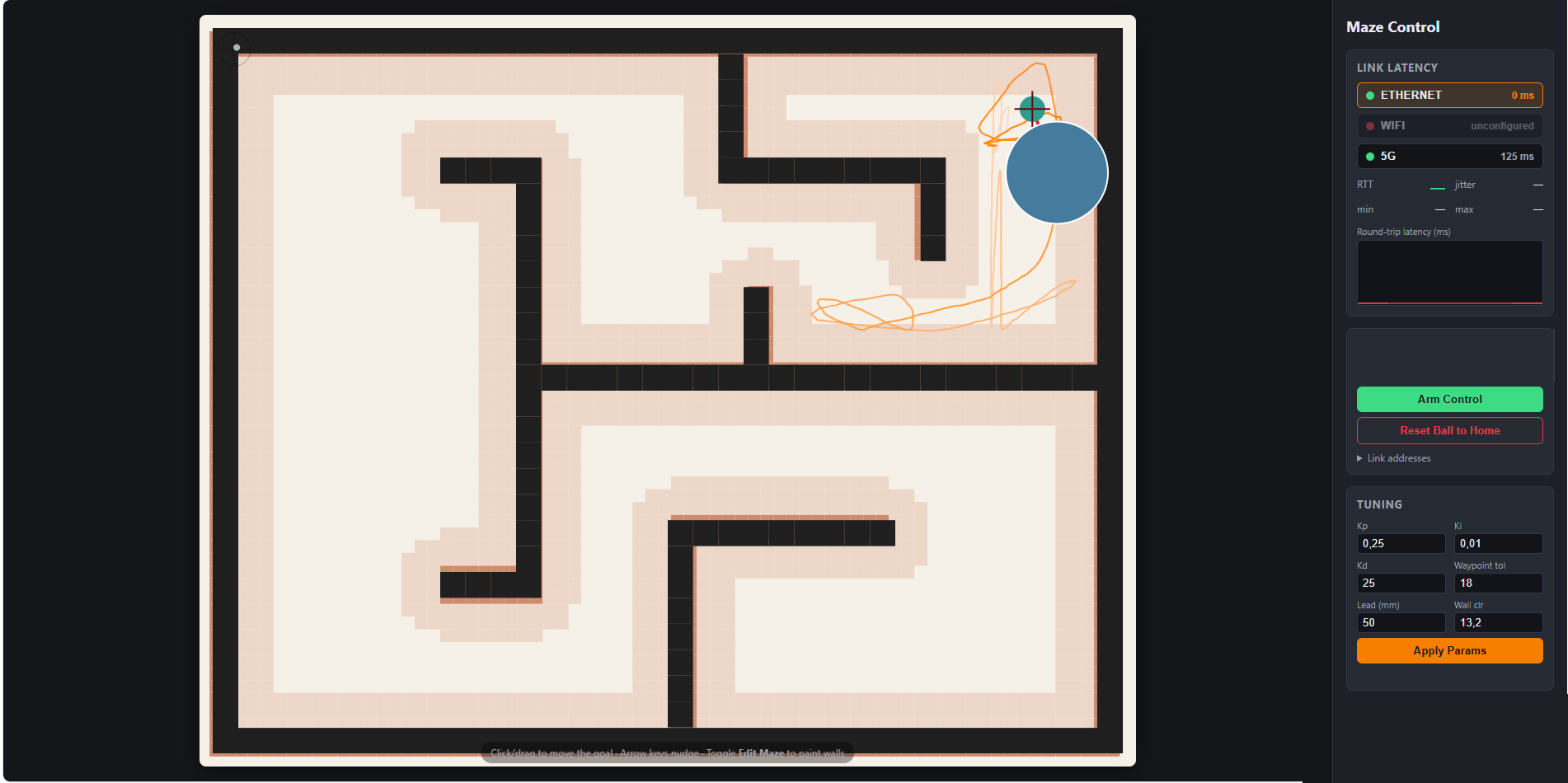
Use
The testbed is used to demonstrate, live, how network and compute choices affect the control of a teleoperated system that spans several machines and depends on fine, responsive control.