MimicVLA: Learning Insertion from Phone Videos
Teaching a simulated Franka Panda to plug in a USB stick from 134 iPhone videos of my own hand, by retargeting the motion in MuJoCo and fine-tuning the SmolVLA vision-language-action model.
Code|Full results|Dataset|Policy
Problem and motivation
USB insertion is hard for a robot: the plug must be aligned to within a millimetre, pushed through contact, and corrected when slightly off. A phone video gives none of that directly: no force, no robot state, and a pose estimate noisier than the tolerance. The question was how far a VLA gets from a small amount of such imperfect human data.
Method
- Track. ArUco markers on the plug and next to the port give the plug tip’s pose relative to the port in every frame, so the handheld camera’s motion cancels. A second plug marker raised tracking coverage from 70% to 90% of frames.
- Replay. The plug-tip trajectory drives the Panda’s end effector in MuJoCo through differential IK. Front and wrist cameras, joint states and 6-D Cartesian actions are recorded at 20 Hz.
- Select. Every clip was reviewed next to its replay; 72 episodes pass the replay gate (64 for training, 8 held out).
- Train and evaluate. SmolVLA is fine-tuned on the demonstrations and evaluated closed loop with 5 seeds per start on 55 start poses no model trained on, with 95% bootstrap intervals.
The simulated port is widened to 15 × 7 mm because the 1–3 mm tracking error is larger than the real port’s 0.7 mm clearance.
Results
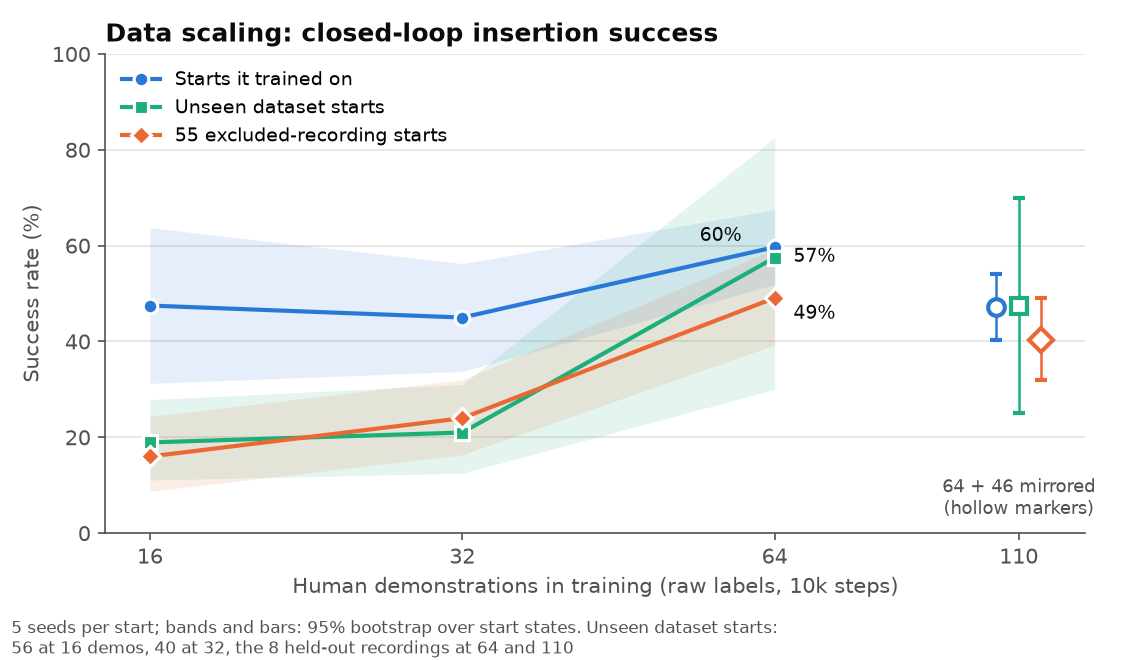
From 64 imperfect demonstrations the policy inserts in 49% [39, 59] of rollouts from unseen starts and 60% [52, 68] from its training starts.
| Policy | Training starts | Unseen starts | Deep-collision rollouts |
|---|---|---|---|
| Raw labels | 60% [52, 68] | 49% [39, 59] | 4% |
| Raw labels + recovery data | 55% [48, 61] | 51% [44, 56] | 14% |
| 2 Hz low-pass labels | 82% [74, 89] | 34% [23, 46] | 61% |
| Low-pass labels + recovery data | 66% [57, 75] | 52% [43, 62] | 44% |
What I learned
- Data quantity dominates. Doubling the data from 32 to 64 demonstrations added 25 points; every algorithmic change moved unseen-start success by a few points at most.
- Noise in human data may be a feature. Smoothing the tracking jitter made the policy fit its training starts better and generalise worse, and DART-style recovery data brought generalisation back. My hypothesis is that the jitter acts as free recovery data; the direct test was not run.
- Evaluation decides the conclusion. A single seed or the 8-clip holdout would have picked the wrong model.
- Negative results: RL on the diffusion noise (DSRL) and mirrored demonstrations gave no gain.
Limitations
Simulation only: no policy ran on hardware, the port is widened, and contact forces (median peaks around 200 N) are too high for a real robot. One person, one port pose.