Autonomous Quadrotor Navigation with MPC
An RRT* global planner and a constrained MPC that tracks its path and avoids obstacles the global plan did not know about, on a simulated quadrotor in PyBullet.
Pipeline
RRT* global planner → MPC local planner → PID attitude controller, simulated with gym-pybullet-drones.
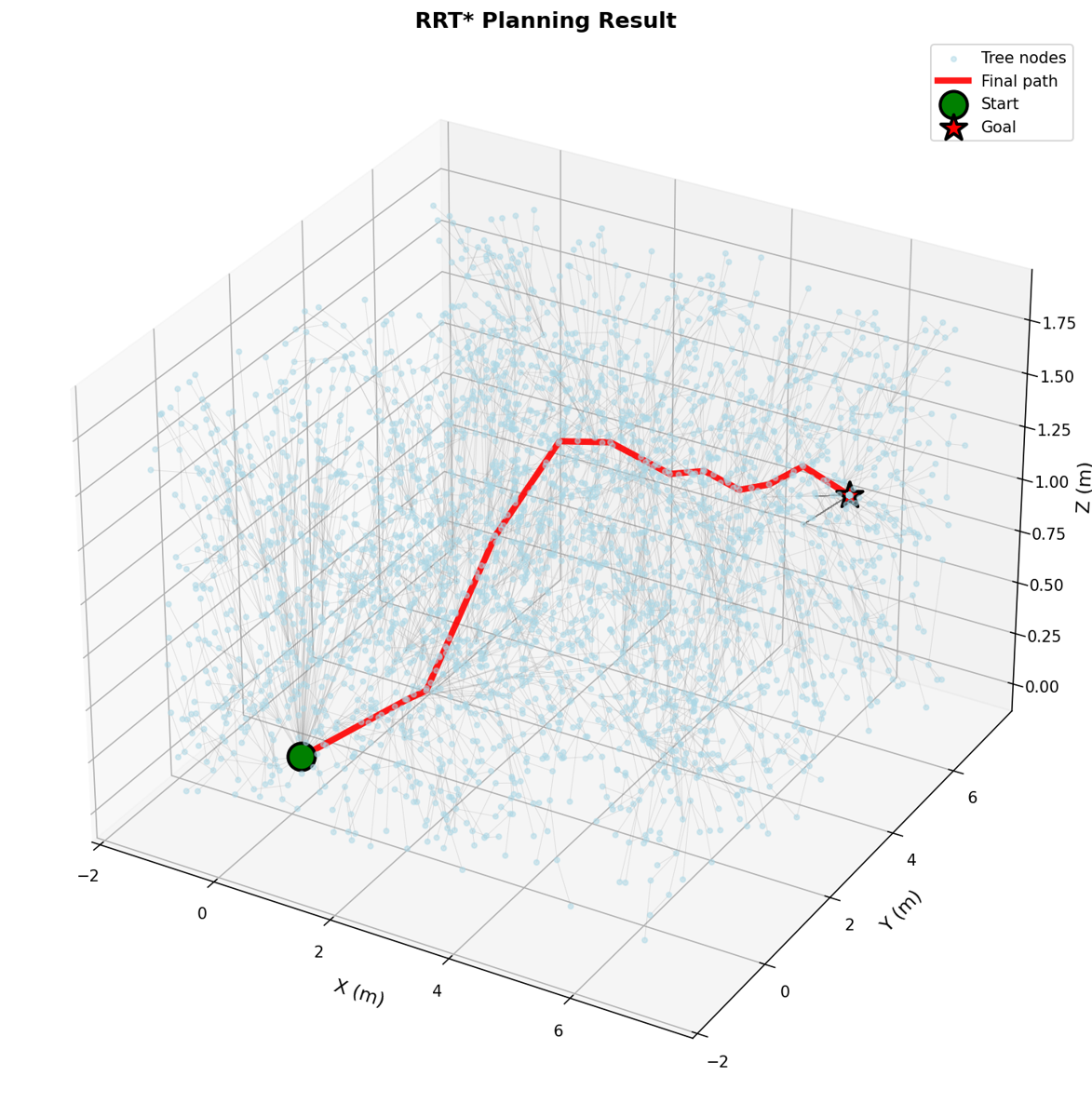
- Global planning. RRT* plans a path from start to goal through the known environment, and the path is smoothed into a reference trajectory.
- Local planning with MPC. A constrained MPC (CVXPY, solved with OSQP, 30-step horizon) tracks that reference. Obstacles are sphere keep-out constraints with slack, so the problem stays feasible when the drone is pushed close to one.
- Low-level control. A PID attitude controller tracks the MPC’s commands.
Obstacles the global plan did not know about
The red spheres are added on the RRT* path after it has been planned, so the global planner never saw them; only the MPC has to deal with them. In the flight above (five extra obstacles), the drone reaches the goal in 14.6 s of simulated time without a collision, with a mean MPC solve time of 5.2 ms.
That run is one of the good ones, not the typical one. Over 16 seeds with a single extra obstacle, the drone reached the goal in 12 runs, but only 4 of those were free of any contact with an obstacle. Making the avoidance reliable, not just possible, is what this setup would need next.